The Challenge
JB Hi-Fi is exploring how to integrate AI-powered search into its retail experience. Before designing anything, we needed to understand the mental models and trust drivers that would determine whether customers would engage at all.
The risk wasn’t building the wrong AI feature. It was building the right feature in a way that eroded trust before customers had a chance to experience its value.
Scoping the opportunity
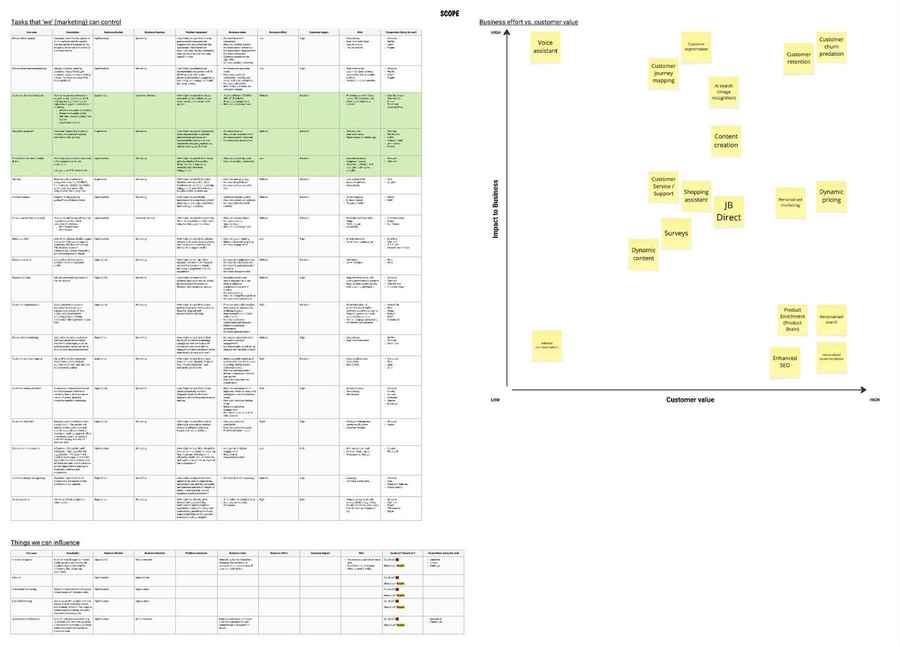
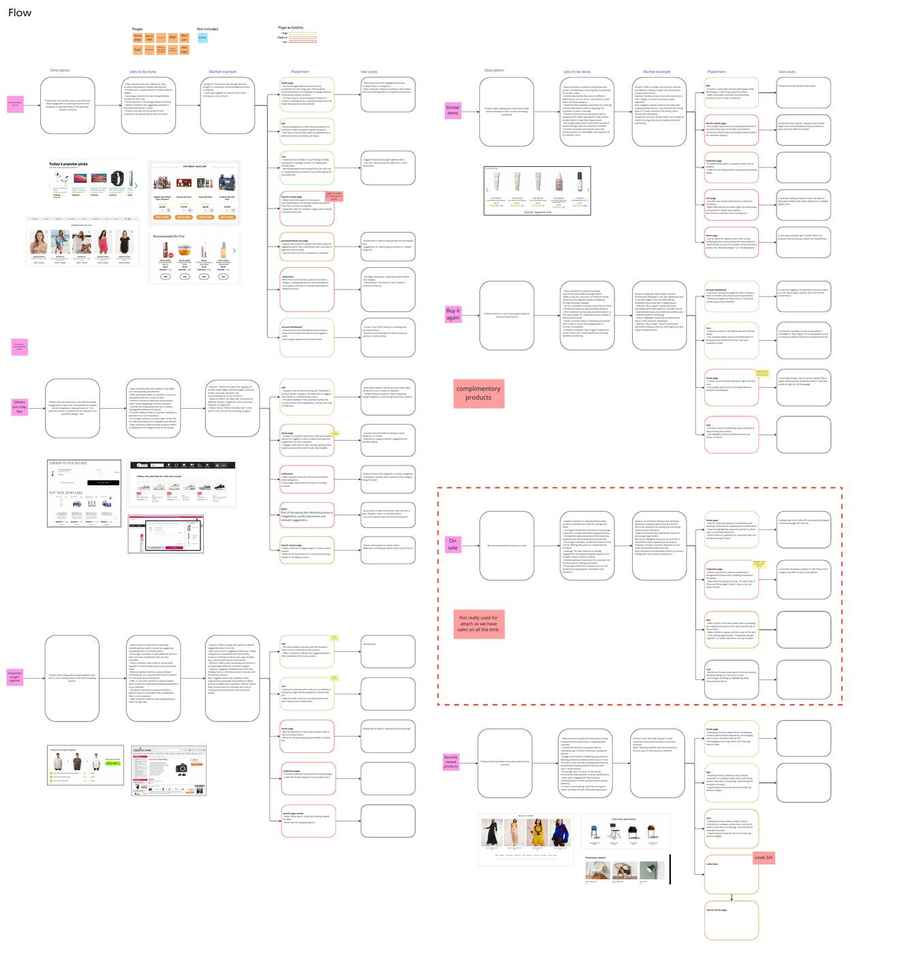
Before committing to any direction, working with the Product Owner, I led a structured exercise to map every potential AI use case across JB Hi-Fi — evaluating each against business effort, customer impact, risk, and competitive landscape. The goal was to separate genuine opportunities from noise, and ensure the team invested in AI initiatives with real commercial and customer value.
The matrix below plots use cases from low to high on both business impact and customer value axes. Highlighted in green are the initiatives already in motion — including AI search, which sits in the high-value quadrant alongside personalised search and shopping assistant. This exercise directly shaped the decision to prioritise AI search as the first live experiment.
AI use case scoping — business effort vs customer value Click to zoom
Research approach
To understand how customers perceive, trust, and adopt AI in a retail context, I ran two studies in parallel.
Survey
- 100 responses
- Ages 22–60
- Male and female
- Familiar with AI tools (ChatGPT, Gemini)
Interviews
- 12 participants, 90-minute sessions
- Ages 22–67
- Male and female
- 2 participants not familiar with AI tools
Key takeaways
Across both studies, three clear themes emerged that shaped every design decision that followed.
Goal 1
Customer perception of AI in retail
- Customers are already using ChatGPT and Gemini
- They expect AI to mirror the in-store experience
Goal 2
Customer challenges in the shopping journey
- Discovery and research are the biggest opportunities
- Turn needs into confident purchase decisions
- Purchase and post-purchase AI is useful — within clear limits
Goal 3
Expected actions AI should complete
- Incorrect AI information breaks trust and harms brand
- High-risk or money-related tasks — customers want a human
- Seamless context transfer to human is critical
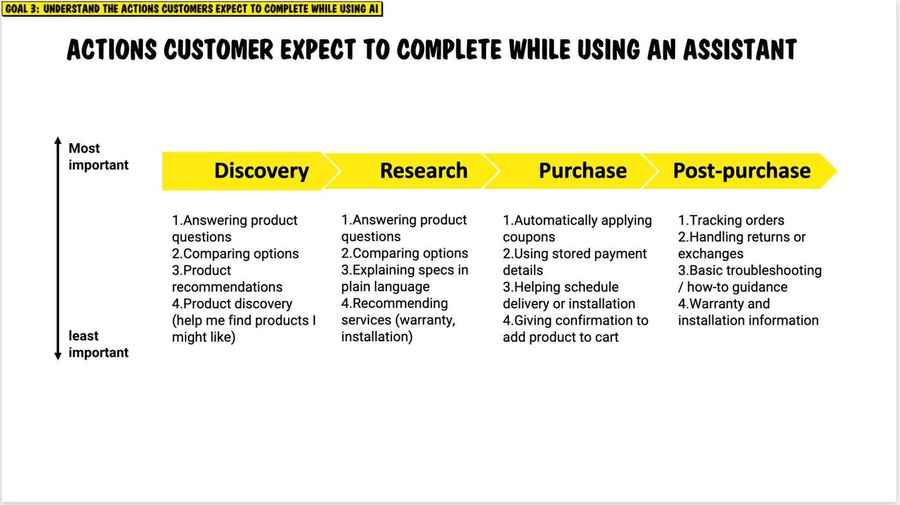
A key output of the research was understanding where AI fits in the shopping journey. I mapped the actions customers expected AI to complete across discovery, research, purchase, and post-purchase — ranked by importance. Discovery and research tasks consistently ranked highest; purchase and post-purchase actions came with significantly more anxiety around trust and accuracy.
Actions customers expect AI to complete — ranked by importance across journey stages Click to zoom
This finding directly shaped the decision to focus the first experiment on search and discovery — the highest-value, lowest-risk entry point — rather than attempting to automate purchase or post-purchase actions before trust had been established.
Design direction
The four takeaways became four design constraints. These weren’t preferences. Each one was a direct response to a specific finding, and any concept that violated them was ruled out before we explored it further.
Constraint 01
Opt-in by default
Never force AI on customers — frame it as a new option, not a replacement for standard search.
From the research: customers who felt they could ignore or override AI were significantly more willing to try it. Forced exposure killed trust before the experience had a chance.
Constraint 02
Transparent reasoning
Show why results are being suggested, not just what they are.
From the research: customers didn't need AI to be perfect — they needed to understand its reasoning. Showing the "why" increased trust more than improving result accuracy.
Constraint 03
Low-stakes entry
Use beta labelling and clear escape paths to reduce perceived commitment.
From the research: customers were more willing to try something unfamiliar when they felt the stakes were low. Beta framing and a visible exit removed the fear of being locked in.
Constraint 04
Conversational framing
Position as a search assistant, not an AI product, to reduce anxiety.
From the research: "search assistant" and "new way to search" outperformed "AI search" in willingness to try. The word "AI" raised the perceived risk; the word "assistant" mirrored the familiar in-store staff experience.
Design concepts
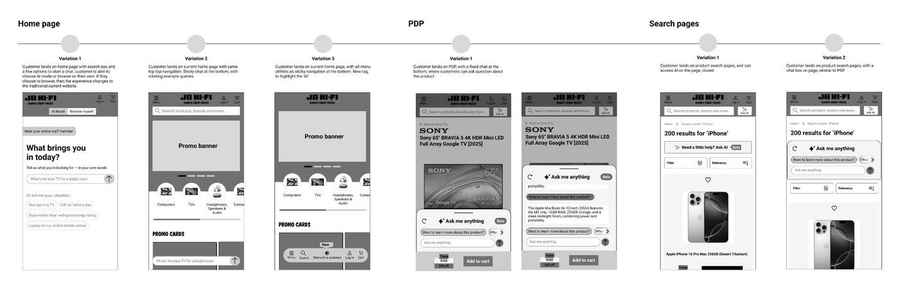
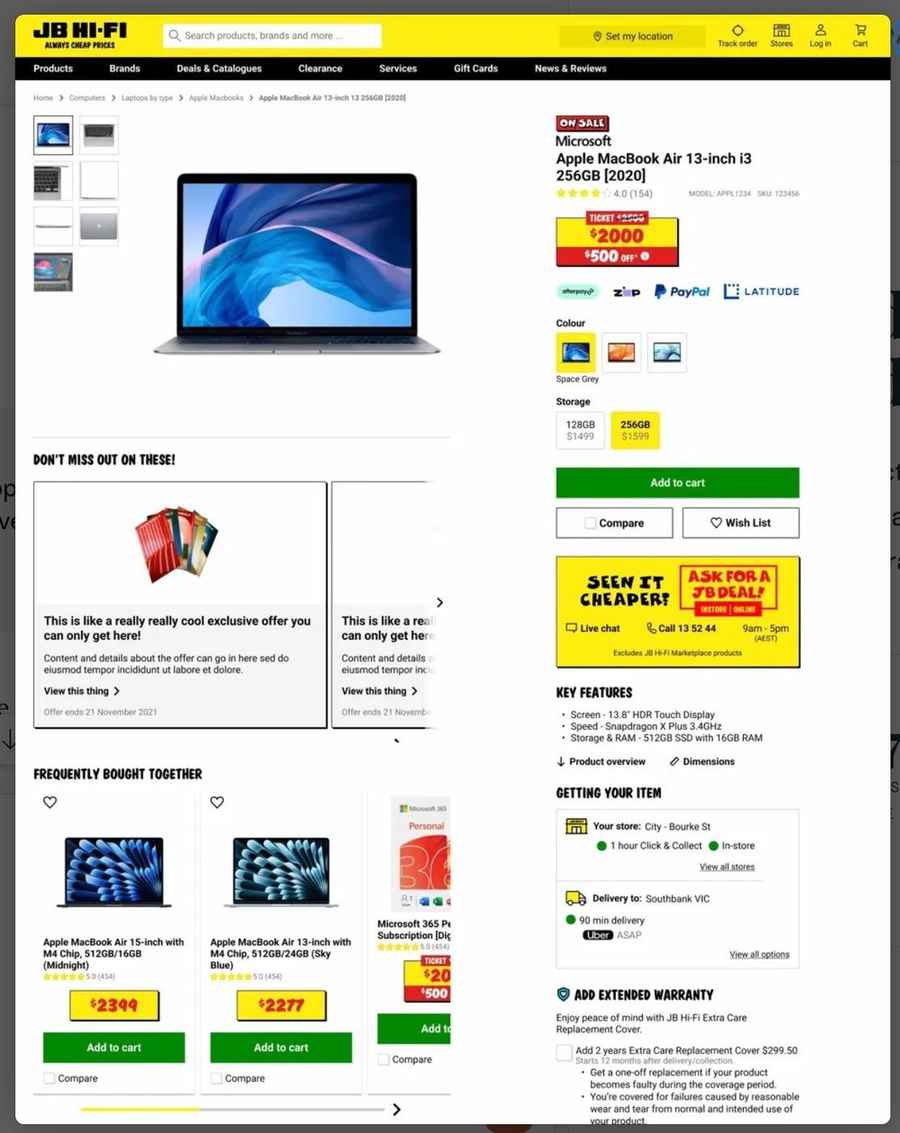
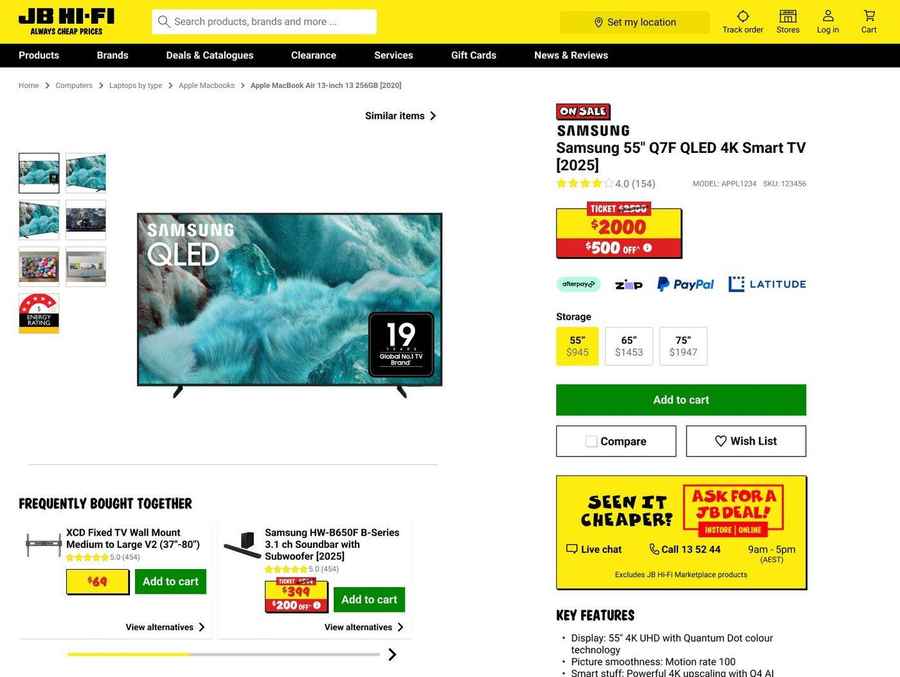
This project is ongoing. In parallel with the live experiment, I am designing across the full end-to-end AI experience — mapping where AI assistance can be introduced at every stage of the customer journey, from home page through to post-purchase. The wireframes below represent current ideation across the home page, PDP, and search results, with the full journey still being defined.
AI entry point concepts — home page, PDP & search pages Click to zoom
Home page
I explored three concepts — from a full AI-mode toggle giving customers the choice to browse with or without AI assistance, to a sticky chat at the bottom, to a subtle menu tag. Each reflects a different philosophy on how prominently to surface AI at the start of the journey.
Product detail page
A contextual AI assistant embedded on the PDP — allowing customers to ask product-specific questions at the highest-intent moment in the journey. Framed as "Ask me anything · Beta" to signal transparency and reduce perceived risk.
Search pages
Two concepts for AI on search results — a subtle "Need a little help? Ask AI · beta" prompt above results, and a more prominent embedded conversational interface. The live experiment tested the latter, informing which entry point drives genuine engagement.
These concepts are early-stage ideation. The live experiment on the search page entry point provided the data foundation to evaluate which direction to progress.
The experiment
The research principles were validated through a live opt-in experiment — an AI-powered conversational search experience, explicitly labelled as beta, framed as "a new way to search." Every design decision I made reflected the research: opt-in entry, transparent framing, visible control, conversational language.
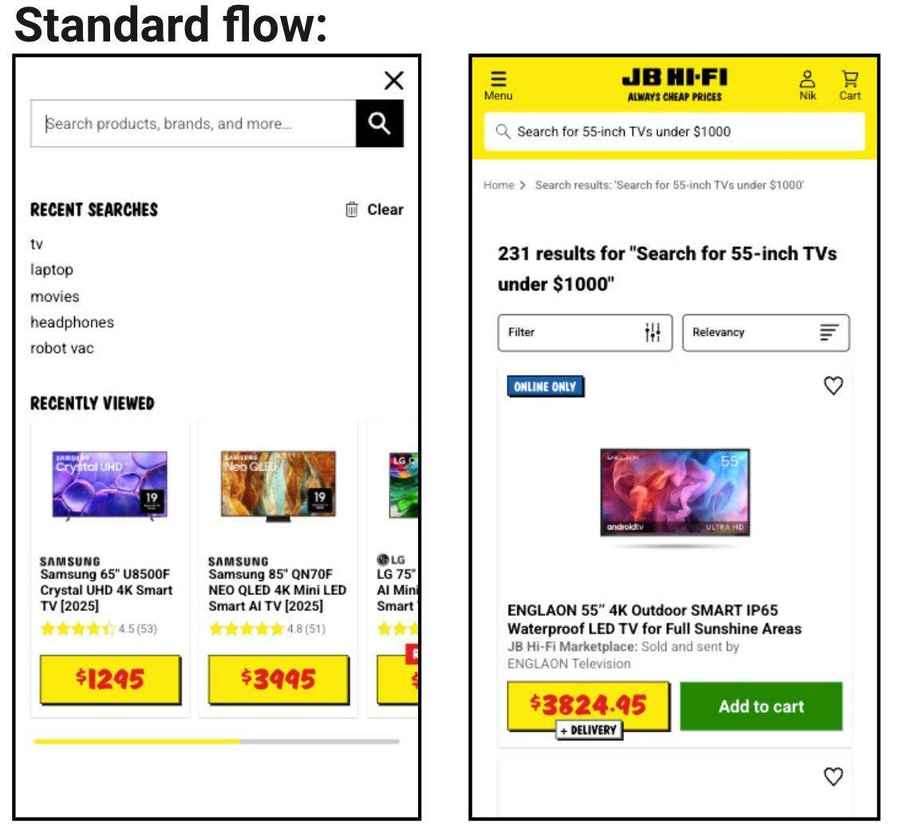
Control — Standard search flow
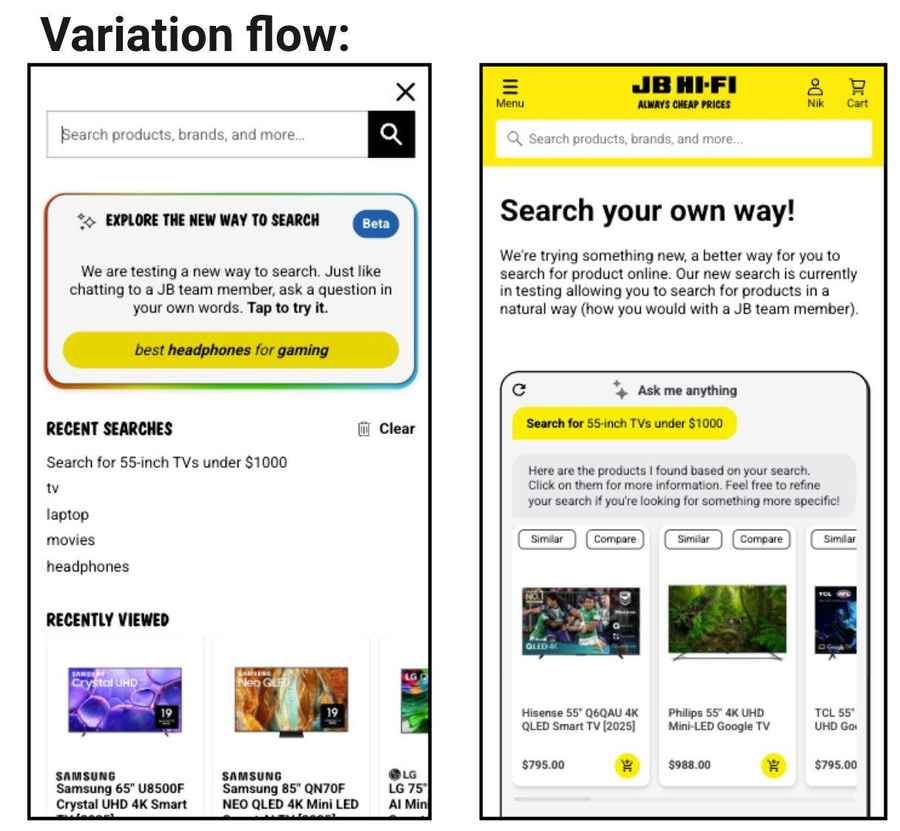
AI flow — Opt-in conversational search
The AI flow introduced an opt-in entry card within the standard search overlay — "Explore the new way to search · Beta" — inviting customers to try a conversational search experience without replacing the existing flow. Customers who engaged entered a natural language search interface, framed as a JB Hi-Fi team member, returning curated results with similarity and comparison actions.
78K
Impressions
over 11 days
1.23%
Opt-in CTR
963 customers
36%
Engagement rate
343 first messages sent
$262
ROI per $1
spent on AI
Purchase conversion rate
1.45%
Control
Standard search
5.36%
AI flow
+3.91 percentage pts
Average order value
$476
Control
Standard search
$503
AI flow
+$27 per order
The CVR and AOV lifts reflect a self-selected, high-intent group — customers who chose to try AI search. The more meaningful signal is the ROI: $134 total cost to run the experiment, against $334K in incremental revenue over 11 days. The case for investment is clear.
The experiment ran for 11 days at a total AI message cost of $134. Incremental revenue attributable to the AI flow was $334K over the period — a $262 return for every dollar spent. This established the commercial baseline for the next phase of investment.
What's next
The experiment validated the core thesis — opt-in, transparently framed AI search drives higher-intent engagement and meaningful commercial return. The next phase focuses on scaling the experience: improving result relevance, reducing the opt-in friction, and testing embedded entry points earlier in the search journey. The research foundation I established in phase one continues to guide every design decision going forward.